

Introducing Astra: AI Powered Contract Intelligence, Now for Everyone


Learn how a robust CLM platform helps ensure compliance and mitigate contract risk, preventing costly legal and financial exposure.



The modern business landscape is plagued by challenges. Whether it’s supply chain disruptions or shifting trade regulations, something is always making operations more complicated. Even attempts to circumvent these issues can backfire.
But true business resilience doesn’t come from trying to guess the market. It comes from building a proactive framework that anticipates threats, including threats from the inside.
Some of these internal threats come from contract compliance. From contract renewals to providing deliverables, there’s a lot to manage here. If a company takes these tasks lightly, it can experience legal problems, financial instability, and lost trust. It may even unintentionally violate local and international regulations.
Luckily, businesses can avoid these problems with proactive compliance risk management. Contracting professionals must learn how to manage compliance risks and build strategic resilience.
Compliance risk management isn’t just a safety measure. It actively promotes business resilience in a number of ways.
Some of the benefits include:
There are two main approaches to risk management — reactive and proactive.
Many companies use the reactive approach. They don’t attempt to predict problems and develop countermeasures in advance. They simply react to compliance issues once one is discovered. For example, if they miss a deadline, they might spend extra resources on damage control, fines, and other forms of remediation. This approach leaves companies vulnerable. It also fosters a culture of constant crisis.
The proactive approach is the opposite. Rather than waiting for problems to appear, proactive risk management attempts to anticipate potential issues. It then develops plans to address those issues. The heart of this approach is the Contract Lifecycle Management (CLM) platform.
These platforms power many of the compliance risk management best practices. For example, proactive companies tend to use CLM-powered analytics as part of their decision-making process. This approach allows them to identify weak points that they might otherwise miss. As a result, companies tend to be very stable while remaining agile and resilient.
The proactive approach takes all the benefits discussed above and expands them. Companies can identify risks and solutions sooner, circumvent legal problems, and consistently deliver on time.
Other benefits include:
Proactive risk management has five major steps. They are as follows:
Companies should start by conducting a comprehensive compliance risk assessment across the entire organization.
Typically, the assessment involves three major stages:
At the end of this process, the current risks facing the company should be clear.
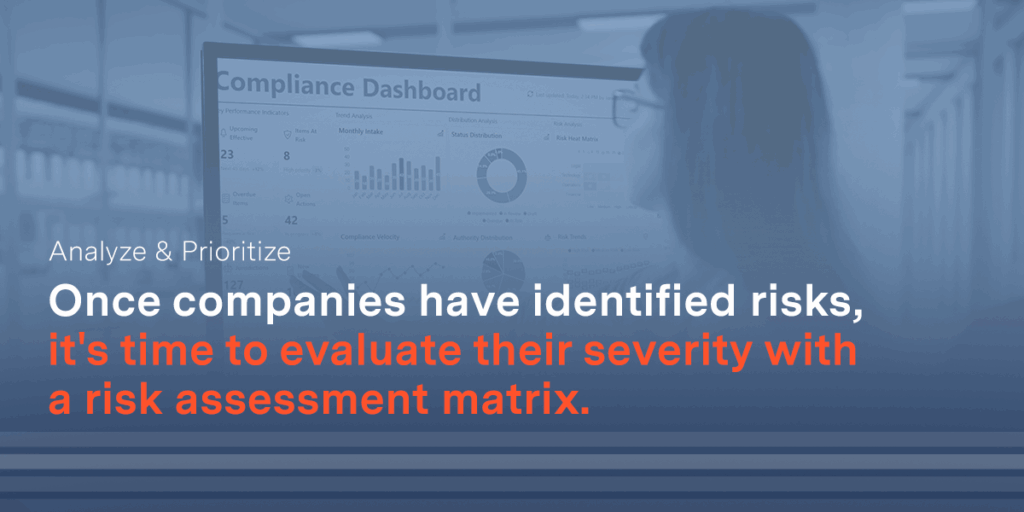
Once companies have identified risks, it’s time to evaluate their severity with a risk assessment matrix. The matrix takes two factors into account: the odds of the risk occurring, and the potential impact of that occurrence.
Typically, the risks are also sorted into tiers to determine which are the most pressing. Many companies use a basic “High, Medium, Low” framework. Some may even use data visualization tools to highlight the most critical risks.
Now, it’s time to address the identified risks. There are two main ways to do so.
The first is to design preventive controls that preemptively avoid compliance issues. For example, many companies use standardized clause libraries and approval workflows to ensure contracts are safe. CLM platforms facilitate both.
The second is to create action plans that mitigate the impact of unavoidable risks. Many supply chain disruptions fall into this category. For example, if flooding impacts a vital port, companies need to have alternatives available.
Compliance risk management doesn’t stop after companies handle current risks. The system must continuously identify and evaluate potential threats as they come.
A CLM platform is the best choice here. It can track Key Risk Indicators (KRIs) and warn companies when they start to increase. It can also send alerts when renewal dates approach or when approvals are needed.
Many companies schedule regular internal audits of their compliance framework to identify weak points and opportunities for improvement.
Once a company has implemented the basic processes, all that’s left is optimization.
There are four main ways to approach this process:
Managing compliance and risk management is made far easier with a CLM platform. It transforms awkward manual contracting processes into highly efficient digital workflows. But the benefits of a centralized data platform don’t stop there.
CLM solutions also:


Learn about the realities of AI today, its limitations and capabilities, and its use as a “force multiplier” for contracting.

If there is one message for tech buyers as we approach 2024, it is that AI is here – ready or not.

With the introduction of ConvoAI, Agiloft delivers the same benefits of simplified AI experiences to the world of contracts.