

Contracts are the foundation of business activity. Nearly every financial transaction within an organization is connected to a contract, from major vendor agreements to smaller internal transactions. Since contracts influence revenue, cost, compliance, and risk, many companies are adopting contract management systems that streamline the process of creating, reviewing, approving, tracking, and renewing agreements. A modern system also improves access to information, strengthens accountability, and protects the organization’s commercial interests.
The term “contract management” can encompass a range of informal processes. In some businesses, it means storing signed PDFs in a drawer. In others, it means monitoring renewals through spreadsheets and team knowledge. A digital contract management system is different. It is a platform that automates Contract Lifecycle Management (CLM) processes and keeps contracts controlled from initial request to final signature and renewal.
Learn the six key benefits of a contract management system, enabling legal and procurement teams to understand how CLM platforms enhance daily work, compliance posture, and long-term business value.
1. Slash contract review and approval times
Approval delays may occur when stakeholders review contracts individually, work from different versions, or respond at varying speeds. A contract management platform eliminates much of this friction by automatically routing documents. Approvals move forward without manual follow-ups, and reviewers receive notifications when it is their turn to act. Collaboration improves because documents remain inside a single workflow instead of circulating through email threads.
Electronic signature capabilities simplify execution once negotiation is complete. Templates and clause libraries allow initiators to generate new contracts using approved language. This reduces the amount of rewriting required during review and improves compliance. When submitting a new request, users enter important details such as contract type, department, urgency, and special terms. By the time a contract reaches Legal or Procurement, all context is already visible. This accelerates internal review cycles and ensures agreements are processed without delay.
The following are key ways a contract management platform accelerates contract review and execution:
- Automated routing: Contracts move to the correct reviewer without manual forwarding.
- Parallel and conditional approvals: Multiple stakeholders review simultaneously, which reduces turnaround time.
- Preapproved templates and terms: Less rewriting and faster alignment with internal policies.
- Electronic signature execution: Signing processes are completed quickly and efficiently.
2. Drastically reduce business risk and boost compliance
One of the main benefits of contract management software is that it reduces three main categories of risk. First, there is compliance management. A digital system records every approval and change in real time, creating a complete audit trail. When audit documentation is needed, teams can retrieve activity history within moments, rather than searching through emails.
Second, there is contractual compliance. The system evaluates supplier and customer agreements and reports on performance, adherence to service-level standards, and regulatory commitments. This supports stronger relationship monitoring and early detection of issues.
Third, standardization decreases risk by ensuring that legally approved language is used consistently. When teams work from controlled templates and clause libraries, contracts align with corporate policy, and fewer liability gaps appear.
3. Gain total visibility with a single source of truth
Manual storage methods make it difficult to track the latest version of a contract and understand its current position in the lifecycle. A contract management platform consolidates agreements in one secure location where authorized users can view status, history, and supporting documents without relying on email chains or local folders. Teams gain clear insight into active contracts, responsible owners, and upcoming milestones, which improves collaboration and reduces uncertainty during review cycles.
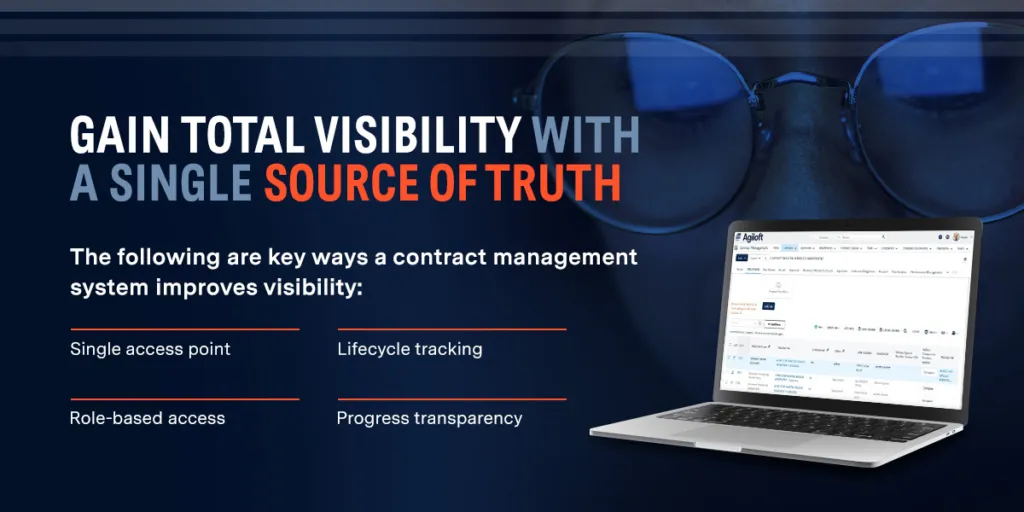
The following are key ways a contract management system improves visibility:
- Single access point: All contract files and approval progress remain in one location.
- Role-based access: Stakeholders view only the information relevant to their work, thereby protecting sensitive data.
- Lifecycle tracking: Users can monitor contract state, task completion, and assigned responsibilities.
- Progress transparency: The status is clear at every stage, reducing the need for manual follow-ups on updates.
4. Never miss a renewal again
A contract management platform reads renewal dates and sends reminders to contract owners before expiration. There is time to evaluate performance, compare pricing, or plan renegotiation strategies. Teams are not forced into last-minute renewals that may result in continued suboptimal pricing or service terms.
Historical contract data support negotiation. Users can review previous performance evaluations, price changes, and obligations. This leads to more informed decisions about rate adjustments, supplier changes, or KPI restructuring. Related agreements become visible, which helps when multiple contracts are connected to the same vendor or business unit.
These renewal insights support both buy-side and sell-side teams. Procurement negotiates with better leverage. Customer teams verify satisfaction ahead of renewal and address issues early.
5. Turn contracts into searchable, actionable data
Information retrieval becomes easier with centralized contract storage. A robust CLM platform enables users to search by keyword, term, or data point across the entire library, including scanned documents that have been converted into searchable text. This reduces time spent hunting for clauses and supports faster internal responses. Teams can answer questions accurately and prepare for meetings without reading entire contracts page by page.
The following are key document management benefits of a contract management platform:
- Full-text search: Users can locate words, phrases, or figures within any contract.
- Searchable scanned documents: Scanned files are converted into text, which allows consistent search across all formats.
- Flexible access options: Authorized users can securely retrieve contract information from multiple devices, supporting modern work environments.
6. Fortify contract security and privacy
File cabinets and shared network folders may feel familiar, but they also introduce access risks and the likelihood of misplaced or unauthorized document sharing. Contract data sometimes includes financial agreements, confidential information, and compliance-sensitive terms. A contract management system centralizes security architecture to protect these assets. Role-based permissions define who can view, edit, approve, or download contract files.
Encryption protects stored and transmitted documents. Authentication settings help prevent unauthorized access. Audit logs document who interacted with a contract and when, which improves accountability and compliance readiness.
Frequently asked questions about CLM
Get your pressing questions on contract management systems answered.
1. What are the capabilities of CLM platforms?
CLM platforms support contract drafting, review, approval routing, storage, search, and renewal tracking within one system. They also provide reporting features that show performance, risk indicators and contract history. These capabilities help teams maintain accuracy and visibility throughout the entire lifecycle of an agreement.
2. What are the main benefits of using a CLM platform?
CLM platforms enable teams to manage contracts more consistently and with reduced manual effort. They reduce approval delays, improve compliance, strengthen document control, and support better renewal planning. These benefits create a more organized and reliable contracting process across all departments.
3. What is the purpose of a contract management system?
Contract management systems help teams draft contracts, manage approvals, store documents, search contract text, and track renewals. Most platforms also provide reporting features that show performance, spend, term details, and contract history.
4. What features should teams look for in a contract management system?
A good contract management system should include workflow automation, searchable document storage, secure access control, and reliable renewal alerts. Reporting capabilities are also important because they enable teams to understand their performance, spending patterns, and contract history. Features such as clause libraries, templates, and electronic signature support further enhance the speed of drafting and execution.
Improve operational efficiency with Agiloft
Legal and procurement teams often lose time searching for files, managing approvals through email, and tracking renewals manually. This increases risk and slows contract work across the business. A contract management system creates structure, improves visibility, and ensures information is available exactly when needed.
It helps teams work faster, stay compliant, and negotiate with confidence. Organizations seeking a more efficient and secure contract process often turn to modern digital solutions that support the entire contract lifecycle.
To learn more about Agiloft's award-winning contract management platform, visit our Contract Management product page.
Request a personalized demo today and explore how Agiloft can help simplify contract management workflows and support long-term contract success.



Learn how Agiloft
can impact your business.
Global users necessitated templates across multiple languages and flexibility to localize
.jpg)

.webp)