

Introducing Astra: AI Powered Contract Intelligence, Now for Everyone


Learn the key similarities and difference between Non-Disclosure Agreements (NDAs) and confidentiality agreements.



Privacy matters — especially in the world of business, where proprietary information is often all that separates success from failure. Non-Disclosure Agreements (NDAs) and confidentiality agreements are two ways companies protect this information from third parties and competitors. Think of them as a legal gag that stops people from sharing sensitive information without the other party giving them permission. If they break that rule, there can be legal consequences.
But what is the difference between NDAs and confidentiality agreements? Understanding the nuances can help your company keep its confidential information safe from third parties, competitors, and the public at large.
Read on to learn how to use each one without compromising proprietary information.
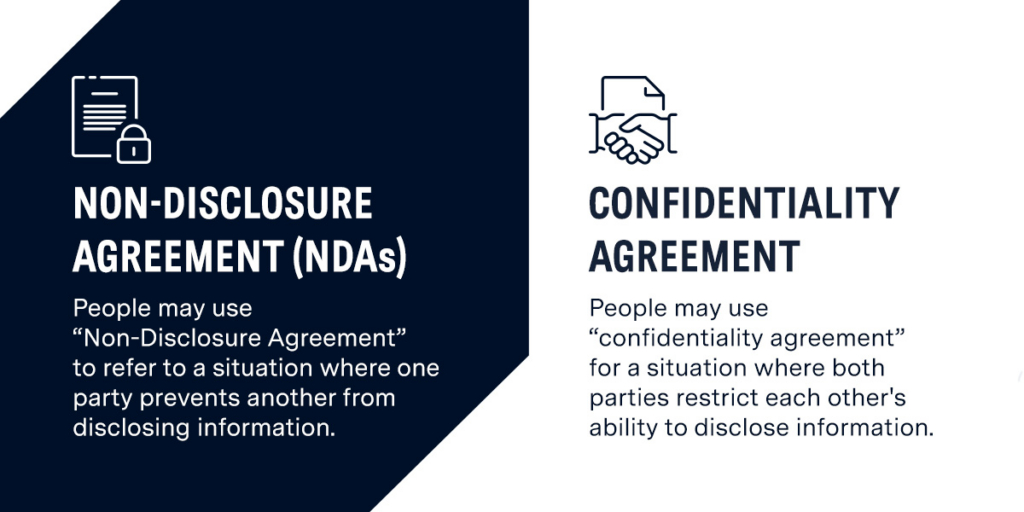
“Non-Disclosure Agreement” and “confidentiality agreement” are terms that are often used interchangeably. You may also hear the phrases “confidential disclosure agreement” or “proprietary information agreement” occasionally. All these terms point to the same basic idea — a legal document that creates a confidential relationship between two or more parties. Some people may prefer one term or the other, but there’s no widely accepted distinction between them.
In some cases, people may use “Non-Disclosure Agreement” to refer to a situation where one party prevents another from disclosing information, and “confidentiality agreement” for a situation where both parties restrict each other’s ability to disclose information. Only a portion of the population has adopted this framing, however. The terms are not considered legally distinct.
If you’re weighing the benefits of an NDA versus a confidentiality agreement, you may be asking the wrong question.
While a non-disclosure agreement and a confidentiality agreement may be the same thing, there are still two distinct types of NDAs. Each one represents a different relationship between those involved.
The first type is the unilateral NDA. In this arrangement, one party tells the other not to share or profit from sensitive information. These NDAs are the bread and butter of confidentiality agreements. They’re typically created by organizations and signed by employees and others who might be privy to sensitive information. For example, a start-up pitching a new technology might ask an investor to sign an NDA to protect its proprietary technology.
The second type is the mutual NDA, which is a bit rarer. These NDAs are used when two or more parties share information between themselves, but don’t want it to be used outside of that. For example, should two companies wish to leverage each other’s technological expertise, they might sign an NDA to keep that knowledge between each other.
Think of unilateral NDAs as a one-way street, and mutual NDAs as a two-way street.
Unilateral and mutual NDAs each offer unique advantages, so it’s important to know when to use them.
Let’s look at some common situations and see which type of NDA suits each one best:
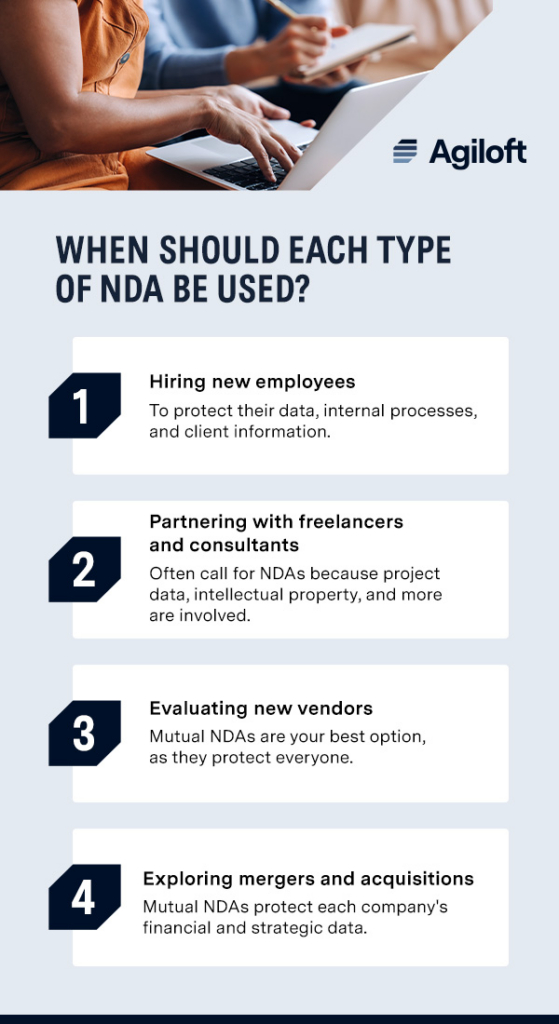
Remember, always commit to an NDA before revealing anything sensitive. It’s the best and safest way to do business.
NDAs are designed to protect confidential information, but it can be hard to tell what counts as confidential. Is there a rulebook governing what is and isn’t sensitive? Is it arbitrary?
The answer is that it’s neither. The contract creator(s) get to specify exactly what is and isn’t deemed confidential. For instance, you might identify customer lists, source code, and financial projections as confidential information. You can then take legal action if that information is shared without your consent.
This power comes with a lot of responsibility. It’s crucial to clearly and precisely define the breadth and scope of the information the NDA covers. Vague terminology leads to loopholes, and if a key category is left out, it will be impossible to win against the other party in court. When drafting an NDA, use many specific categories to make sure all your bases are covered.
The NDA should also define carve-outs, or exceptions, that don’t count as confidential information. Common carve-outs include information that the signer already knows, information that becomes public knowledge, and information that develops independent of the NDA. These carve-outs protect the signer and clarify what they can legally discuss outside a courtroom.
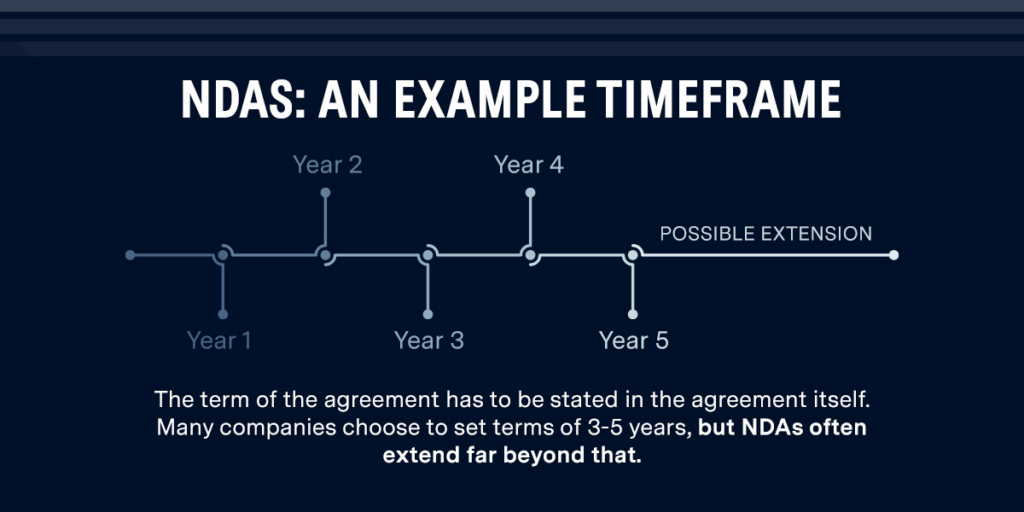
The NDA’s time frame is not automatically indefinite, either. The term of the agreement has to be stated in the agreement itself. Many companies choose to set terms of 3-5 years, but NDAs often extend far beyond that. Once it approaches its expiration date, the NDA can be renewed or allowed to expire. If it expires, the confidential information it protected can be shared and used.
There is an exception, however. Some parts of the agreement can include a survival clause, which extends the term for those categories. Trade secrets, for instance, are often given an indefinite survival period so that, even after the NDA expires, the trade secrets can’t be used legally. These additional clauses are a great option due to the fact that some information is always worth protecting.
That said, terms and survival clauses shouldn’t be abused. If the agreement doesn’t set a reasonable term for expiration or overuses survival periods, it may be unenforceable in court.
A poorly-crafted NDA doesn’t just happen overnight. It’s often the result of poor day-to-day operations over time. But which ones, specifically?
Compare your NDA process to the list of potential problems below and see if anything raises a red flag:
A vague, contradictory, or inappropriate NDA can open the door to several problems, such as legal issues or an inability to protect trade secrets.
But that’s not all. Low-quality NDAs can have more subtle negative effects on your business, including:
Luckily, you can address common NDA-related issues with a Contract Lifecycle Management (CLM) platform. These systems allow your company to embrace digital contracting by creating, managing, and monitoring all types of agreements within a single system. No more information siloes — handle everything from NDA creation to contract negotiation in the same place.
Other features include:
Building and monitoring an NDA can feel like an uphill battle, especially when it’s one of many complex contract management processes. Simplify things for yourself and all your teams with Agiloft’s award-winning CLM platform. More than 95% of our customers stick with us because our data-first CLM platform streamlines contract creation, boosts visibility across teams, and organizes every single company contract in one easy-to-use interface.


Learn about the realities of AI today, its limitations and capabilities, and its use as a “force multiplier” for contracting.

If there is one message for tech buyers as we approach 2024, it is that AI is here – ready or not.

With the introduction of ConvoAI, Agiloft delivers the same benefits of simplified AI experiences to the world of contracts.