

Introducing Astra: AI Powered Contract Intelligence, Now for Everyone


Learn about the basics of digital contracting and how a data-first contract management platform can help your organization reduce risk and bottlenecks across the enterprise.



Contracts form the cornerstone of all business operations, regardless of company size. These documents legally govern interactions between companies, clients, and employees, making them essential for business success and risk management.
But a lot of companies are still using pen, paper, and emails to manage these critical documents. This manual method slows contracting processes across their entire lifecycle. It also makes people spend their precious time and energy on processes that could be automated with the proper oversight and guardrails. Ultimately, these manual processes put the contracts themselves at risk.
Digital contracting is the solution. It transforms static documents into valuable contract data points to help guide and protect your business, and makes contract management simpler and faster. And that’s just the beginning of the practical benefits of this approach. Keep reading to learn more about digital contracting and how it can modernize your company.
“Digital contracting” is just what its name implies: the creation, negotiation, and management of contracts using digital tools. The cloud and Contract Lifecycle Management (CLM) software are two of these tools. Think of digital contracting as a high-powered sports car to manual contracting’s horse and buggy. It is faster, easier, and opens up a world of possibilities.
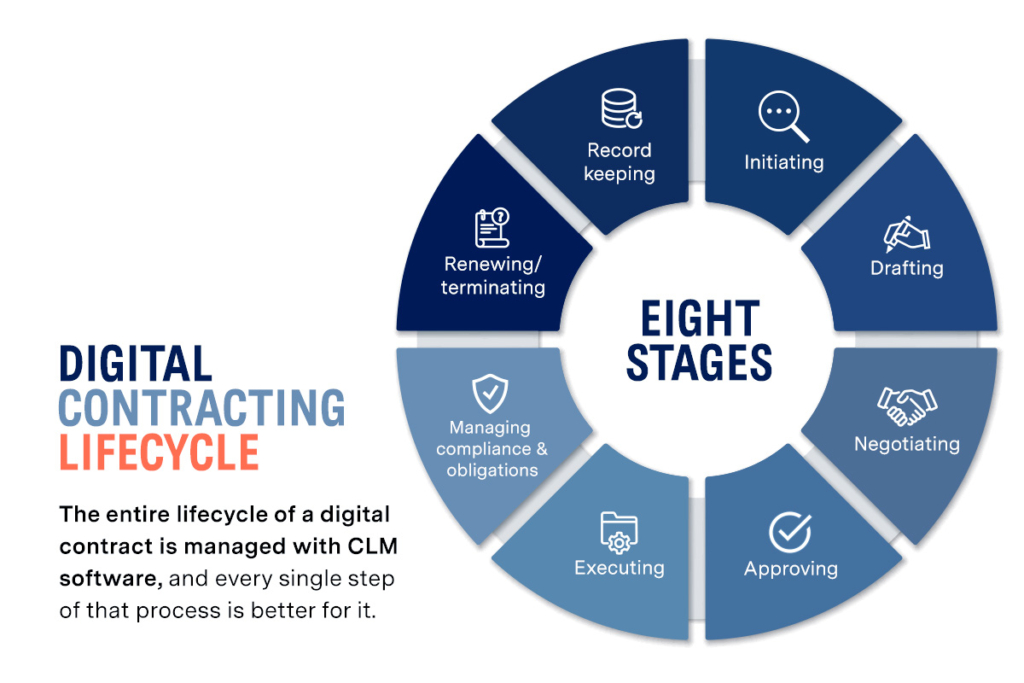
The manual contracting lifecycle has eight stages spanning from initiation to termination and record keeping. Conventionally, businesses handled each step in-person or through email. Now, it’s possible to manage the entire lifecycle with CLM software to promote higher accuracy and efficiency throughout.
Here’s how:
The benefits of digital contract management extend beyond contract lifecycles and benefit your business’s most critical operational teams.
Digitizing a contract increases its visibility across legal and compliance teams, giving these team members easily accessible insights into contract language. With digital contracting, compliance errors become easier to identify and resolve. Many CLM platforms provide pre-approved clause libraries to make resolving discrepancies even easier.
Plus, you can automate parts of the review process. Automation gives legal teams a second set of eyes during manual reviews and reduces the overall workload. Then, legal professionals can focus on higher-value, more strategic work.
The platform also logs any changes made to your company’s contracts for review whenever necessary. This way, the legal team can easily retrieve and revise the document or revert to a previous version.
Sales teams also benefit from contract digitization. Because CLM platforms often speed up contract negotiations, they can indirectly increase revenue. Electronic contract workflows might let you hire new reps sooner or close a deal in half the time.
Customer and supplier contracts often use distinct language, which can be confusing when comparing them for decision-making purposes or running numbers. Digital contract software can standardize this language across documents to make evaluating different terms faster and easier.
CLM platforms also help Sales streamline its contracts and renewal processes. This can support speedier negotiations and less time spent sending emails back and forth.
CLM platforms strengthen both strategic decision-making and budgeting. Contract data helps finance teams keep track of expenses, which can then inform budgeting and future financial decisions.
CLM software also helps Finance identify contracts that break the rules or can’t be executed. Team members can then renegotiate those terms in an effort to cut costs or increase company value.
You can even integrate your CLM platform with your company’s Enterprise Resource Planning (ERP) and financial planning software to automate data entry.
Our award-winning CLM platform helps organizations save money and reduce risk with easy-to-use interfaces, intuitive navigation, and powerful contract management features spanning the entire lifecycle. That’s why more than 95% of our customers choose to stick with us each year.

Learn about the realities of AI today, its limitations and capabilities, and its use as a “force multiplier” for contracting.

If there is one message for tech buyers as we approach 2024, it is that AI is here – ready or not.

With the introduction of ConvoAI, Agiloft delivers the same benefits of simplified AI experiences to the world of contracts.