


You sit down in the chair. General Counsel. Chief Legal Officer. Deputy General Counsel leading a critical function. And the realization arrives quietly: this job is not about better lawyering. It is about leading an operating system that must deliver at scale and velocity, with actionable insight in a world propelled forward by AI.
Legal departments do not struggle because their lawyers lack legal skills. They struggle because they are rarely designed, governed and evolved as operating systems—and the people leading them were trained as technicians, not executives. To close that gap and lead your team to the promised land, start with answering the question most legal leaders skip entirely: Why are you here? Not why the legal function exists. Why you, specifically, are leading this team, at this organization, in this moment.
This is not a motivational exercise. It is the first operating decision of your tenure, and it rests on four foundations—followed by the hardest question.
4 Foundations to Lead Yourself Before You Lead the Function
1. Management is Not Leadership
Management keeps a system stable and moving in its current direction: planning, budgeting, staffing, controlling. Leadership is attracting people to follow you as you change direction. You can manage a legal department competently for years without ever leading it—the contracts get reviewed, the filings go out on time, but the function never evolves.
When you undertake real transformation, the existing management infrastructure—incentives, cultural norms, reporting lines -—rely keeps pace. Your leadership fills that void, and purpose is the fuel for it. Titles create compliance. Purpose creates commitment.
2. Put On Your Own Oxygen Mask First
You cannot lead others through change if you have not first examined your own motivations. This is not therapy; it is preparation. A leader with a clear, internalized “why” sustains focus through ambiguity, makes harder trade-offs with more consistency and invests more fully in outcomes—because the work is personally meaningful, not merely professionally obligatory.
And it cannot be faked. People detect inauthenticity with remarkable speed. When you articulate your “why,” you are coding a signal to everyone in the organization: is this a transaction or is this a relationship? Get it right and your people will extend discretionary effort. They will commit—because they believe you will take care of them when things get uncertain.
3. Product-Market Fit for Leadership
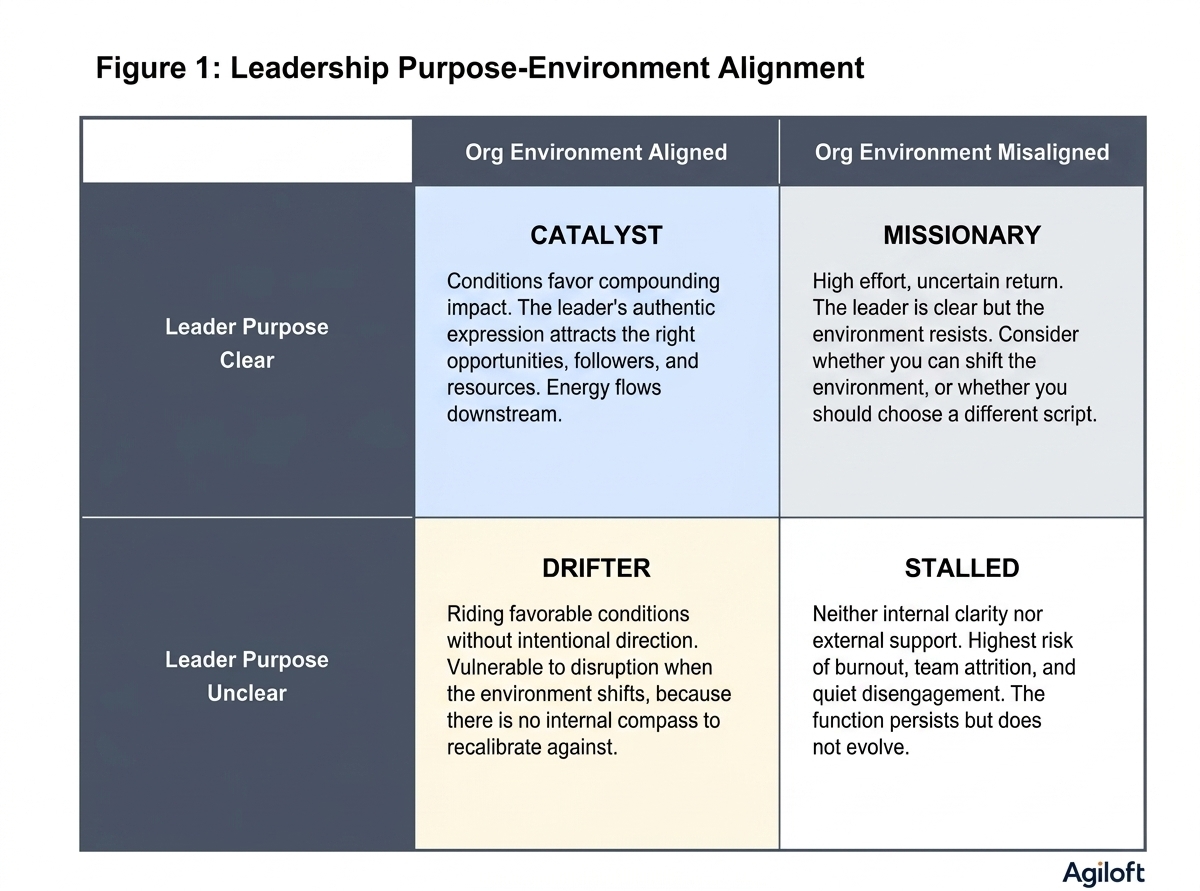
A clear “why” is necessary but insufficient. It also has to fit your environment—think of it as product-market fit applied to leadership. Your purpose is a cube with many faces: the CFO needs to see the cost face, the business unit president the velocity face, the team the growth face. The mature leader turns the cube for the audience while staying authentic.
But if you are a highly relational leader and your organization defines success almost exclusively as cost reduction, you will be swimming upstream—your wins invisible to the people who decide your future. One diagnostic worth running: how many opportunities have you turned down? Not projects. Roles, jobs, organizations. If the answer is “none,” the diagnostic is overdue.
4. Credibility Times Conviction Equals Inspiration
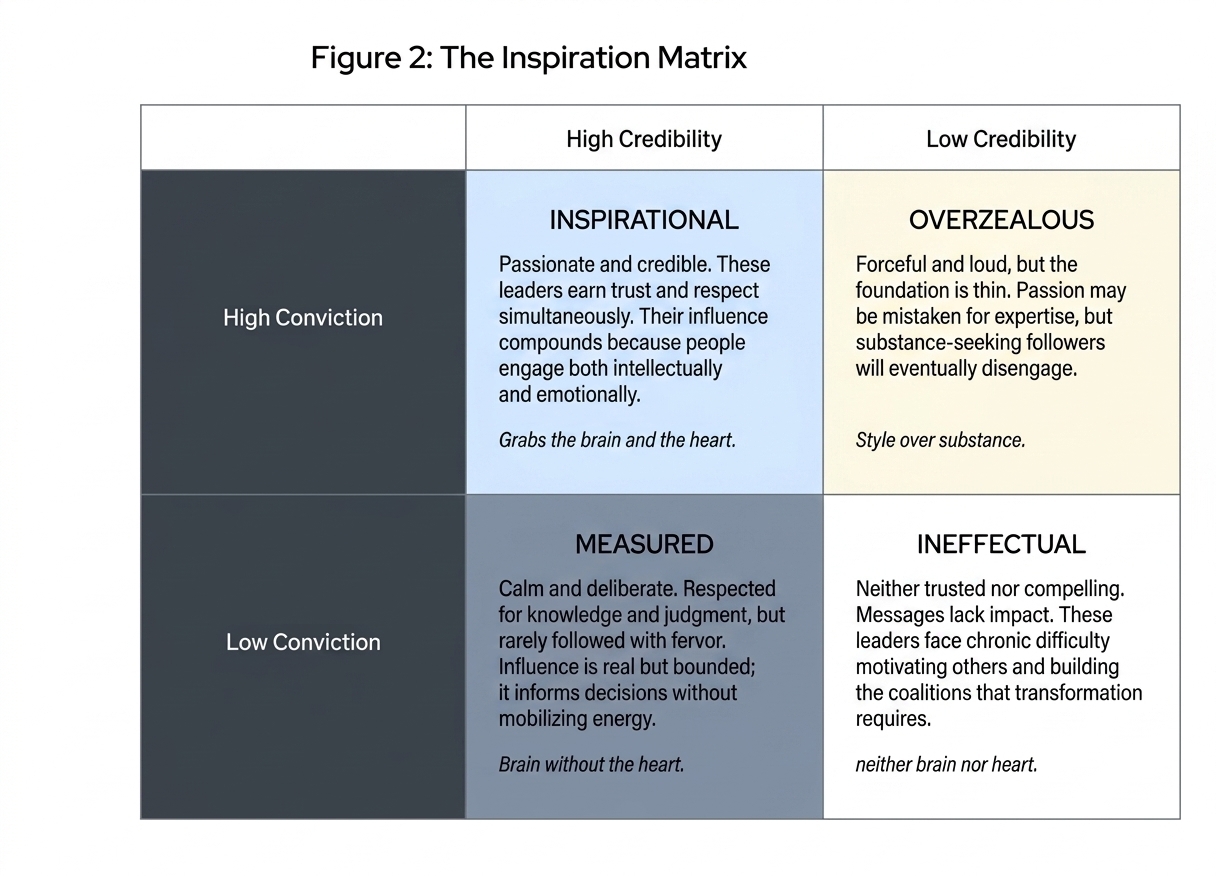
Credibility is whether people believe you are competent—it grabs the brain. Conviction is whether people believe you believe -— grabs the heart. The highest form of leadership grabs both.
Here is the uncomfortable truth for legal leaders: law firm training builds credibility almost exclusively. Conviction was probably never mentioned during your years as an associate. But conviction cannot be manufactured—it is the external expression of internal clarity. Do the work of deciding what you believe and conviction follows. Skip it, and no amount of polish will hide the gap.
The Hardest Question
We began with a quiet realization: the job is not about better lawyering. We end with a question that is louder than it appears—Are you in the right job? And if not, are you prepared to quit today?
That is not reckless advice; it is the logical endpoint of the diagnostic. Most leaders who work through it do not discover they are in the wrong job. They discover they never deliberately chose the one they are in. Making that choice on purpose is the foundational operating decision of your leadership—everything else builds on it.
So before you lead the function: Why are you leading at all?
This is a condensed version of the prologue to a 12-month executive curriculum, The Executive Toolkit to Unlock Modern Legal, built on a four-layer Legal Executive Leadership System: Diagnostic, Structural Design, Change Engine, and Measurable Business Outcomes. Each monthly installment delivers frameworks, diagnostics, and actionable guidance for CLOs, GCs, DGCs, and AGCs leading operational transformation. To read the full article, click here.


Learn how Agiloft
can impact your business.
Global users necessitated templates across multiple languages and flexibility to localize
.jpg)
.webp)